Is Badaling Worth Visiting?
The section every coach goes to, split into a steep north route and a quiet south one. Which side to walk, when to arrive, and who should go somewhere else.
- Distance from Beijing
- 80 km
- Drive time
- 75 min
- Restoration
- Fully restored
- Crowds
- Very high
- Opening hours
- 06:30–16:30
- Best for
- A half-day trip
- Tickets at the gate
- Advance booking only
Last checked on July 20, 2026.
| Ticket | High season | Low season |
|---|---|---|
| Entrance ticket | CN¥40≈ $6 | CN¥35≈ $5 |
| Child / student entrance | CN¥20≈ $3 | CN¥18≈ $3 |
| Cable car, return | CN¥140≈ $20 | CN¥140≈ $20 |
| Cable car, one way | CN¥100≈ $15 | CN¥100≈ $15 |
| Pulley car, return | — | — |
| Slideway ride down | — | — |
Official gate prices in CNY. Online resellers add a service fee. Last checked on July 20, 2026.
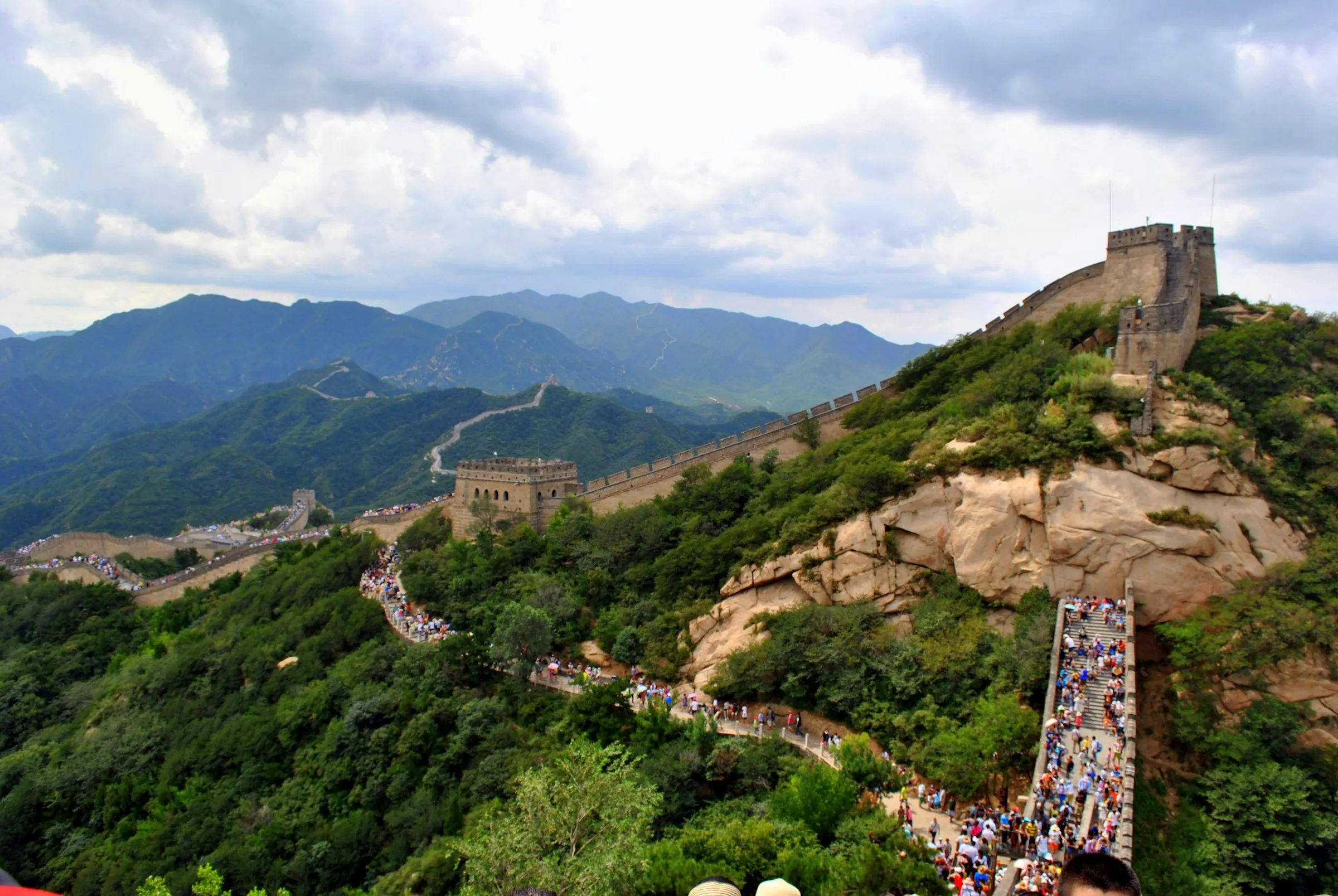
Badaling is the easiest section of the Great Wall to reach and the hardest to enjoy in peace. It is the one with a railway station, a direct city bus and the full weight of Beijing’s coach traffic — which makes it the obvious choice without a car and the wrong choice on a summer Saturday. Arrive at opening and you get a genuinely dramatic stretch of restored wall; arrive at eleven and you get a queue on stairs.
What Badaling is
This is the section China has been showing visitors the longest. It opened to tourists in 1957 as the first stretch of the wall prepared for visits, and it has received hundreds of visiting heads of state since. That history is visible everywhere: broad paved approaches, restaurants, souvenir arcades, a station, and a wall rebuilt to carry more people than any other part of it.
The wall itself deserves its reputation. It runs high along a ridge with long sightlines in both directions, and the climbs are steep enough that the towers arrive as a relief. What you are trading for that is solitude.
North route or south route
From the entrance the wall splits, and the two directions make different days.
| North route | South route | |
|---|---|---|
| Character | Steeper, higher, the classic views | Shorter, gentler, fewer people |
| Crowd | Where nearly everyone goes | Quiet even when the north is packed |
| Lift | Cable car to the high ground | Pulley car partway, and a slideway back down |
| Walk it if | You want the view from the top | You want the wall to yourself |
The north route carries the traffic and the aerial cable car, which runs from the Guntiangou car park up to North Tower 8; the south is the shorter stretch with milder ground, reached by a rail funicular from the Zhan Tianyou memorial to South Tower 4, with a slideway back down.
Most visitors do not know the south route exists, which is exactly why it works. If your priority is photographs without strangers in them, turn that way at the entrance and let the coaches go the other.
Crowds, and the only reliable way around them
Badaling absorbs more visitors than any other section, and it runs a daily visitor limit that is genuinely reached on weekends and around Chinese public holidays. Timing beats every other tactic:
- First entry of the day is the difference between an empty parapet and a slow-moving line on the stairs.
- Weekdays outside the summer peak are another section entirely.
- Winter changes the section more than any other factor — see below.
- The national holiday week in early October is the one period to avoid outright — how to avoid the crowds.
What the walking is like
Steep, stepped and uneven, with long ramps between towers and steps of inconsistent height. The parapet is wide, which helps, but the crowd narrows it in practice: on a busy day the constraint is other people, not gradient.
The cable car removes the climb to the high ground on the north route, and the pulley car does something similar on the south, but neither makes this a flat walk — you still cover the wall on foot once you are up there. If someone in your group cannot manage sustained stairs, read what to expect at Mutianyu before committing to Badaling: the lifts there land you on gentler ground.
Shoes matter more than fitness. So does wind: the ridge is exposed and colder than the city, in every season.
The base area
Badaling has the most developed infrastructure of any section — restaurants, shops, toilets and staffed information points near the entrance, plus a museum area covering the wall’s construction and the Ming defensive line. That cuts both ways: everything you need is there, and so is everyone else.
The museum is easy to skip on a short visit, and worth remembering on a cold day or with children who have run out of stairs — it is a real part of the day rather than filler.
Two practical notes. Food and drink cluster at the base rather than along the wall, so carry water up. And the walk from the station or the bus stop to the entrance area is longer than most people picture, before any wall-climbing starts.
Winter is the version people do not plan for
The section that is unbearable in August is genuinely good in January. The crowd thins to a fraction, the air is clearest of the year, and the ridge line reads properly when the trees are bare. What you pay for it is cold that the city forecast understates, wind on the exposed stretches, and ice on stone steps that were already uneven.
Two adjustments make it work: warmer layers than the temperature suggests, and the enclosed lift rather than the open one, which is also the ride least likely to be stopped by weather.
Getting there
This is Badaling’s real advantage: it is the only major section with its own railway station, served by both a slow scenic line and fast trains, plus a direct city bus from Beitucheng metro. No transfers, no last-mile taxi.
The route-by-route detail is on Badaling Great Wall by train and bus to Badaling; the wider comparison of ways out of the city is on how to get to the Great Wall from Beijing.
Booking your visit
Entry is sold online in advance under real-name rules and tied to the passport entered at checkout, and this is the section where the daily limit actually binds. Popular dates disappear before the day arrives, so treat the ticket as the first thing you fix once the date is set.
Ticket types, what the lifts cost and which combination suits your route: book tickets. The procedure itself, including what foreign visitors trip over, is how to book Great Wall tickets online. If your date has already gone, what to do when tickets are sold out ranks the alternatives.
Should you come here at all?
Yes if you are without a car, short on time, travelling in winter, or you want the section with the most dramatic profile and do not mind sharing it.
No if you want a quiet walk, if you are travelling with people who tire in crowds, or if photographs matter more to you than convenience. In those cases Mutianyu is the standard answer, and the full comparison is Mutianyu vs Badaling.
Maybe if your day is very short: Badaling is quick to reach, but the closest section to Beijing shows where it actually sits against the alternatives.
What’s next
- Comparing it with the usual alternative: Mutianyu vs Badaling.
- Getting there without a car: Badaling Great Wall by train.
- Sorting entry: book tickets.
| Option | Duration | Cost |
|---|---|---|
| Train京张高铁 (Qinghe)Qinghe · about hourlyFirst 06:16 · Last back 20:43 | 20m | CN¥25≈ $4 |
| Train京张高铁 (Beijing North)Beijing North · about hourlyFirst 07:29 · Last back 21:13 | 35m | CN¥31≈ $5 |
| TrainS2Nankou · a few departures a day | 1h 20m | CN¥7≈ $1 |
Prices and timetables change — figures below were last checked on July 20, 2026.
Frequently asked questions
Is Badaling worth visiting?
Should I walk the north or the south route at Badaling?
How crowded is Badaling really?
Is Badaling suitable for older visitors or children?
Keep planning
- The Best Section of the Great Wall of China to VisitSeven sections near Beijing make very different days out. A straight verdict for each kind of visitor, and the three questions that decide which one is yours.
- Mutianyu Great Wall: What to Expect and How to VisitWhat the Mutianyu visit is actually like: the layout tower by tower, which stretch of wall to walk, and how the two lifts and the toboggan fit together.
- Mutianyu vs Badaling: Which Section to ChooseSame restored wall, two very different days out. How Mutianyu and Badaling compare on crowds, climbing, lifts and transport — plus a verdict for your trip.
- Closest Great Wall Section to Beijing: All Seven RankedJuyongguan is the shortest run out of the city, Badaling the quickest by public transport. How the seven sections rank when the day is already short.
- Badaling Great Wall Tickets: Booking and the Daily CapAdmission is the easy part; the lift you buy depends on which side of the wall you walk. What to book at Badaling, and why the daily limit decides your date.
- How to Book Great Wall of China Tickets Online 2026Great Wall tickets are sold online under real-name rules, and the busiest sections hit a daily quota. How to book with a passport and what happens at the gate.
- Badaling Great Wall by Train from BeijingTwo rail services reach Badaling and they suit different days. What each one is, how booking works with a passport, and why the station itself needs extra time.
- Bus to Badaling Great Wall from BeijingWhere to board now that the route has moved, how to spot the fake departure offers, and why the return leg is the part to check before you go rather than after you arrive.
- Mutianyu Cable Car and Toboggan Tickets 2026Every lift on the Great Wall is a separate purchase with its own gate and rules. What each one is sold as, how to book it, and what happens when it closes.